
The Problem: The plant goes quiet, and the riskiest work of the year begins
Thanksgiving is tomorrow, and for many plants the next big date on the calendar is the holiday shutdown. Christmas falls on a Friday this year and New Year's Day on the next Friday, so a lot of sites will go dark for the week in between and restart on Monday, January 4. Production stops. Maintenance does not. The shutdown list fills up with the jobs nobody could do while the line was running: gearbox rebuilds, conveyor belt changes, hydraulic repairs, electrical upgrades, tank and duct cleaning, and the contractor work that needs the whole area down.
All of that work runs on one safety system: the control of hazardous energy, or lockout/tagout. And that system is still one of the most cited in the country. In OSHA's preliminary list for fiscal year 2026, published in September, Control of Hazardous Energy (29 CFR 1910.147) moved up from fourth to third among the most frequently cited standards. Safety+Health magazine's full-year breakdown, published November 22, counts 2,172 lockout/tagout violations and ranks the standard second among violations cited as serious.
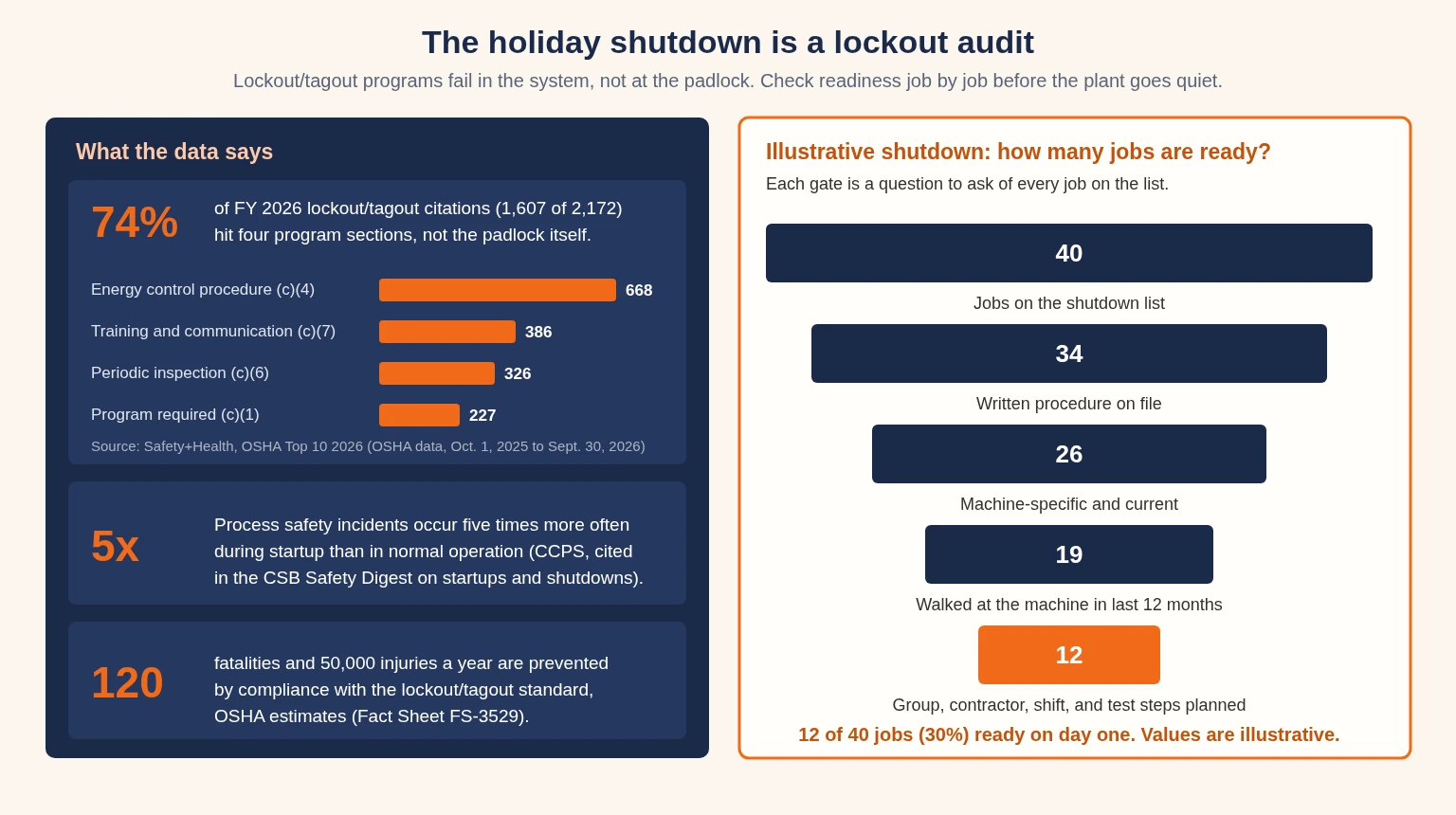
The detail is more useful than the rank. The top cited parts of the standard were the energy control procedure (668 violations), training and communication (386), periodic inspection (326), and the requirement to have a program at all (227). Together those four account for 1,607 of the 2,172 citations, about 74 percent. Those are not padlock failures. They are system failures: procedures that are missing or generic, training that did not stick, and annual inspections that did not happen. Presenting the list, OSHA's Prent Cline put it plainly: "In every one of these cases where we get a violation, there's a failure to manage the worksite."
A holiday shutdown puts every one of those weak points under load at the same time. More non-routine jobs, more crews working on the same equipment, more contractors, longer shifts, thinner supervision, and a restart at the end that everyone wants to finish quickly. The U.S. Chemical Safety Board made the same point about process plants in its Safety Digest on startups and shutdowns: citing the Center for Chemical Process Safety, it notes that process safety incidents occur five times more often during startup than during normal operations, and cites a refining study that put half of process safety incidents in startups, shutdowns, and other infrequent events.
Naming the failure: the Quiet-Plant Assumption
We call it the Quiet-Plant Assumption: the belief that a stopped plant is a safe plant. The line is silent, the lights are low, and the hazards feel like they went home with the production crew. They did not. A press that is off can still have a raised ram held by hydraulic pressure. A conveyor that is stopped can still be under belt tension. A pipe that has been drained can still hold heat, pressure, or chemical residue. A breaker that is open can be closed by someone who does not know a technician is inside the machine.
The Quiet-Plant Assumption also shows up in planning. Shutdown planning usually focuses on parts, people, cranes, and contractor schedules, which is right. Energy control gets one line: "LOTO per site procedure." That line assumes that every job on the list has a current, machine-specific procedure, that the people doing it are trained on it, and that the hard parts (group work, contractors, shift changes, testing, and restart) are already worked out. In the citation data above, those assumptions are where programs fail.
Why this is a system problem, not a padlock problem
Most sites already have locks, tags, and a written program. Three quality ideas explain why that is not enough during a shutdown:
- A procedure is standard work, and standard work must match the job as it is. The standard requires documented procedures for each piece of equipment, with only a narrow exception for simple machines with a single energy source and no stored energy. A generic procedure that says "isolate all energy sources" is like standard work that says "build the part correctly." It does not tell anyone which valves, which breakers, which bleed points, or how to verify zero energy on this machine. Equipment also changes. A procedure written before last year's retrofit can miss the new air supply or the added drive.
- Readiness drops at every gate. In the illustrative example in the chart, a site plans 40 shutdown jobs. Thirty-four have a written procedure on file. Twenty-six of those are machine-specific and match the equipment as it stands today. Nineteen were walked at the machine by a second authorized person in the last 12 months. Only twelve also have the group, contractor, shift change, and testing steps planned. That is 30 percent of the list ready on the first day of the shutdown. The numbers are made up to show the pattern, not drawn from any plant, but the funnel is how to check your own list.
- The riskiest moments are the transitions. The standard has specific rules for exactly the situations a shutdown creates. Group lockout needs one authorized employee with primary responsibility for the crew and, when several crafts or departments are involved, one person to coordinate the whole job (paragraph (f)(3)). Contractors and the host site must tell each other about their lockout procedures (f)(2). Shift and personnel changes need a specific procedure for handing over lockout protection (f)(4). Temporarily removing locks to test or position equipment has its own required sequence (f)(1). And before energy is restored, the area must be inspected, employees safely positioned or removed, and affected employees notified (e). Each of these is a handoff, and handoffs are where communication errors live.
OSHA estimates that compliance with the lockout/tagout standard prevents about 120 fatalities and 50,000 injuries each year, and that workers injured by hazardous energy lose an average of 24 workdays. The program works when it is used as designed. The goal for the next four weeks is to make sure it is ready for the specific jobs on your shutdown list.
How to retire the Quiet-Plant Assumption before the shutdown

You do not need a new program. You need to run the program you have against the actual shutdown list, while there is still time to fix what you find:
- Map every shutdown job to its energy control procedure: Put the job list in one sheet and add a column for the procedure number. Flag every job that has no procedure, a generic one, or one older than the last change to the equipment. Sort the gaps with a Pareto view by area or equipment type so the fixes go where the gaps cluster. The lockout/tagout procedure and audit sheet is built for this kind of coverage check.
- Walk the procedure at the machine before December 18: For the highest-energy jobs, have an authorized employee who is not the usual user take the procedure to the equipment and find every isolation point, bleed point, and verification step. This is the periodic inspection the standard requires at least annually (c)(6), and it should end with the procedure corrected and the inspection certified. Label isolation points so they match the procedure. That is visual management applied to safety.
- Name one coordinator for each group lockout: For any job with more than one crew or craft, assign the authorized employee who owns the group lockout and coordinates the work, and decide how each worker attaches a personal lock to the group lockbox and how the coordinator confirms who is still inside. Put the name on the job plan, not just on the day.
- Exchange procedures with every contractor before they arrive: The standard requires the host and the outside employer to inform each other of their lockout procedures, and the host must make sure its own people understand the contractor's rules. Do it in writing during contractor onboarding, walk the job together, and use a job hazard analysis for non-routine tasks. The JHA risk assessment builder can help structure it.
- Write the transitions into the job plan: Shift changes, lock removal for testing or positioning, and verification of zero energy should be steps on the plan, not left to memory. Make verification hard to skip: a required try-start or meter check before work begins is a form of mistake-proofing. Long shutdown shifts and holiday staffing make the handover step more important, not less.
- Treat the restart as its own procedure: Plan the restart as carefully as the teardown. Inspect each area, account for every person, notify affected employees, and have each lock removed by the person who applied it. Anything changed during the shutdown (a new motor, a rerouted line, a modified guard) should go through management of change and a pre-startup review, and the energy control procedure should be updated before the equipment returns to service. Schedule the restart with a rested crew, not at the end of a 12-hour shift.
After the restart, close the loop. Record every near miss and every procedure that did not match the machine, and run them through incident and near-miss investigation while memories are fresh. Next year's shutdown starts with this year's findings.
Practical takeaways for this week's Gemba walk
Spend an hour with maintenance at the equipment, not in the planning meeting:
- Pick three jobs from the shutdown list and take the procedures to the machines: Count the isolation points on paper and on the equipment. If the numbers differ, or if the procedure says "all energy sources," you have found your first fix. Use the Gemba walk approach: observe and ask, do not audit people.
- Ask the contractor coordinator, "Whose locks go on first, and whose come off last?": If the answer is not immediate and the same from both the host and the contractor, the group lockout plan needs work.
- Ask, "Who restarts this line on January 4, and what do they check first?": If nobody is named, or the answer is "we hit start and see," the restart is not planned yet.
A quiet plant is a busy plant
The OSHA data tells a consistent story year after year: lockout/tagout programs fail in the system, not at the padlock. Procedures that do not match the machine, training that did not stick, and inspections that never happened. A holiday shutdown concentrates that risk into a few days of non-routine work, shared equipment, contractors, and a restart. Treat it the way you would treat any high-risk change: build the list, check the standard work against the real equipment, plan the handoffs, mistake-proof the verification, and learn from what you find. Do it now, while there is still time to fix a procedure before someone needs it.
Educational use only: this issue is written from a quality and operations perspective by a quality professional, not a safety professional or lawyer, and is not legal, engineering, or regulatory compliance advice. Requirements are summarized from 29 CFR 1910.147; read the standard and any state plan or industry-specific rules that apply to you, and have qualified safety professionals review your energy control program. The shutdown example is illustrative.
Next Issue Preview
Next time we pick another corner of the improvement toolbox, chosen from what is happening on real floors this month. Stay tuned.
Call to Action
Before December 4, take your holiday shutdown job list and add one column: the energy control procedure for each job and the date it was last walked at the machine. Count how many jobs are truly ready, and schedule the walkdowns for the rest this month. Send me your count, anonymized. P.S. Share this with your maintenance manager, your safety lead, and whoever schedules the contractors for shutdown week.
Newsletter replies and questions: [email protected]
Follow updates on X.com: @kaizen6sigma
References
- OSHA, "Top 10 Most Frequently Cited Standards" (preliminary, fiscal year 2026)
- Kevin Druley, "OSHA’s Top 10 2026," Safety+Health (National Safety Council, November 22, 2026)
- 29 CFR 1910.147, "The Control of Hazardous Energy (Lockout/Tagout)" (eCFR)
- OSHA, "Lockout/Tagout" Fact Sheet FS-3529
- U.S. Chemical Safety and Hazard Investigation Board, "Safety Digest: CSB Investigations of Incidents during Startups and Shutdowns"