
The Problem: The year-end close starts on January 4, and the pile is already waiting

This year, December 31 falls on a Thursday and New Year's Day on a Friday. For most finance teams, the first business day of the year-end close is Monday, January 4, 2027. Between the Monday after Thanksgiving and New Year's Eve there are about 23 working days, before anyone takes vacation. Most teams will spend those days on the normal December month-end, holiday parties, budget meetings, and covering for people who are out. Then on January 4 they will open the year-end close and find all of its work waiting for them at once.
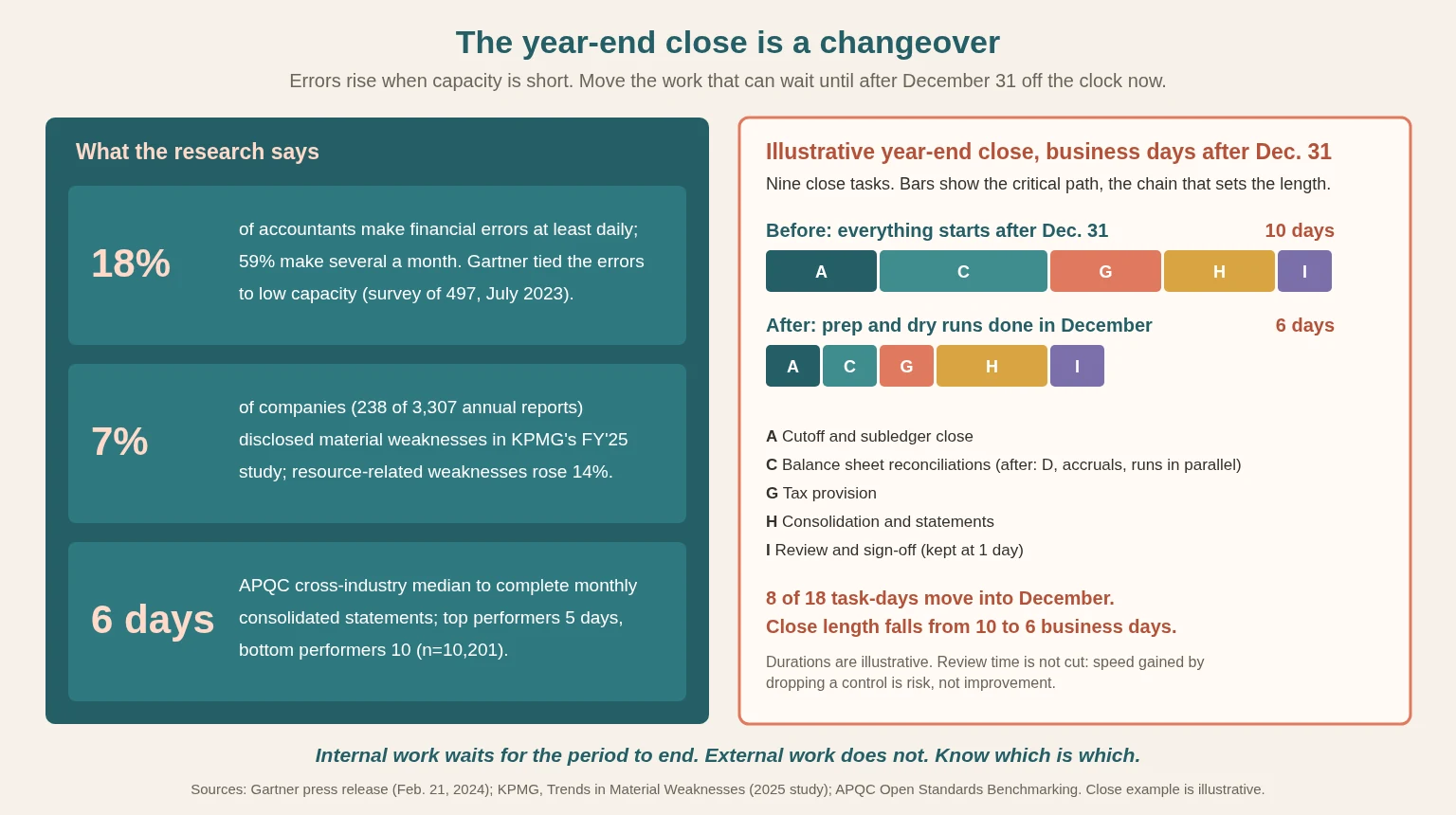
That pile matters for quality, not only for speed. In a Gartner survey of 497 people in the controllership function (conducted in July 2023 and published in February 2024), 18% of accountants said they make financial errors at least daily, about a third make several errors a week, and 59% make several errors a month. Gartner linked those errors closely to low capacity. 73% of the accountants said new regulations had increased their workload over the previous three years, and 82% said economic volatility had increased demands on their work. The error types in the survey included manual work, insufficient review, and reopening the books.
Public company data points the same way. In KPMG's 2025 study of material weaknesses, which uses Audit Analytics data, 238 of the 3,307 annual reports filed (7%) disclosed a material weakness in internal control. The top root-cause themes included a lack of documentation, policies, and procedures, and a lack of accounting personnel or expertise. Weaknesses tied to inadequate accounting resources rose 14% from the previous year, and weaknesses tied to journal entry controls rose 3%. There is good news too. Ideagen Audit Analytics counted 391 financial restatements in 2025, down 18% from 477 in 2024 and the second-lowest count in its 20-year database. Reporting quality can improve when the process gets attention.
A rushed January is exactly when capacity is shortest. The year-end close adds work that the monthly close does not have, such as inventory and fixed asset rollforwards, reserve and bonus estimates, the tax provision, and the auditors' request lists. If all of it starts after December 31, the same people do more work in fewer days, review gets squeezed, and errors become more likely.
Naming the failure: the Day-One Pile
We call it the Day-One Pile: all the close work that sits waiting for the first business day after year-end even though it never needed the year to be over. Some close work really does need final numbers. December cash cannot be reconciled until December is over. A lot of it does not, though. Most estimate methods, intercompany balances through November, fixed asset additions through November, the consolidation template, a tax provision dry run, and the list of support the auditors will ask for can all be done before the period ends.
Manufacturing solved this exact problem decades ago. It is called a changeover.
Why the close is a changeover, and why that matters
In SMED (single-minute exchange of die), Shigeo Shingo split changeover work into two kinds. Internal work can only be done while the machine is stopped. External work can be done while the machine is still running: staging the next die, preheating it, and laying out the tools. Shingo's first and most powerful step was not to work faster. It was to look at every changeover task, ask which ones really had to happen with the machine stopped, and move everything else outside the stoppage.
The year-end close fits this model closely. The "machine stopped" time is the business days after December 31, when leaders, lenders, and auditors are waiting for the numbers. Internal close work needs the final period data. External close work only needs preparation, earlier data, or an agreed method. Three ideas follow from that:
- Only the critical path sets the length. A close is a chain of dependent tasks. Moving a task that is not on the critical path earlier frees people but does not shorten the close. Moving the critical tasks does. Our month-end close guide works through this for a routine month. The year-end close has more tasks on the chain, so it gains more.
- Moving work earlier is a quality move, not only a speed move. Work done in December is done with more time, more people, and time to ask questions. Gartner tied errors to low capacity, so moving work out of the tightest window should reduce errors as well as days. That is the same logic as SMED reducing setup scrap: a calm, staged changeover makes fewer mistakes than a rushed one.
- Never buy speed by cutting the review. In SMED you shorten the changeover, not the first-piece inspection. In the close, review and sign-off are the inspection. Speed gained by skipping a review is risk, not improvement, and the KPMG data shows that review and journal entry controls are where weaknesses show up.
The chart shows an illustrative year-end close with nine tasks. When everything starts after December 31, the critical path (cutoff, balance sheet reconciliations, tax provision, consolidation, review) takes 10 business days, which would mean Friday, January 15 on this year's calendar. If the team reconciles through November and most of December before year-end, agrees estimate methods and intercompany balances in December, and dry-runs the tax provision on November numbers, 8 of the 18 task-days move into December. The close drops to 6 business days, or Monday, January 11. Consolidation and review keep their full time. The durations are made up to show the effect. Your own will differ, and you can test them in the close calendar critical path calculator. For scale, APQC's Open Standards Benchmarking puts the cross-industry median for completing monthly consolidated financial statements at 6 calendar days, with top performers at 5 and bottom performers at 10.
How to shrink the Day-One Pile before the holidays

You do not need a new system. You need about two hours with the people who did last year's close, and then a few weeks of discipline:
- List last year's close as it really happened: Start from your close checklist, then add what actually happened: the day each task started and finished, who did it, and what it waited for. Include the work that was not on the checklist, such as chasing a missing invoice or rebuilding a broken spreadsheet link. This is the SMED step of filming the changeover. You cannot separate internal from external work until you can see all of it.
- Mark every task internal or external: For each task, ask one question: "What in this task truly needs December 31 data?" Often the answer is "only the last part". Split those tasks. Agreeing the accrual method, building the schedule, and loading November actuals are external. The December true-up is internal. Do the same for the tax provision, inventory reserves, and bonus accruals.
- Convert external work in December, on purpose: Schedule it on the close calendar like any other task, with an owner and a date. Typical moves are a soft close on November books, a consolidation and tax provision dry run on November numbers, an intercompany cutoff date in mid-December for agreeing balances, fixed asset rollforwards through November, and getting the auditors' request list now so support can be gathered before January. If you do a physical inventory count before year-end with a rollforward, agree the approach with your auditors first.
- Reconcile continuously, not in a batch: A reconciliation done once a month is a batch, and batches hide problems until the end. Reconcile the high-risk accounts weekly in December, so that on January 4 only the last days of activity are left. Track the share of reconciliations that pass review the first time. A p-chart of reconciliations sent back will show whether the process is stable or whether one account family keeps failing.
- Mistake-proof the manual journal entry: Manual entries are where capacity-driven errors land, and journal entry controls are one of the KPMG themes. Use mistake-proofing, not reminders. Examples include templates that do not accept an entry unless it balances and has a valid account and period, required support attached before posting, standard recurring entries set up in December instead of keyed by hand in January, and a check that flags entries just above or below review thresholds. Use your internal controls to design these steps, and keep the person who reviews an entry separate from the person who prepares it.
- Level the load and protect the review: Use the idea of heijunka and plan people, not just tasks. Put vacations and holiday coverage on the close calendar, give each critical task a trained backup, and protect review time on the schedule, so the reviewer is not also the person catching up on the Day-One Pile. Track post-close adjustments after year-end. If they go up while days go down, the faster close came from cutting quality.
After the close, run a short retrospective while it is fresh. Put every late task and post-close adjustment on a Pareto chart, ask 5 Whys on the top two, and update the close calendar and standard work for next year. That is how a one-time push becomes a better process.
Practical takeaways for this week's Gemba walk
For finance, the Gemba is the close calendar, the reconciliation tracker, and the desks of the people who do the work. Spend an hour there this week:
- Ask, "What did you wait for most last January?": Ask the person who prepared last year's hardest reconciliation, not their manager. The answer is usually a document, a number, or a decision from someone else. Find out whether that wait can be removed in December.
- Pick three tasks scheduled for January 4 and 5 and ask what needs December 31: For each one, ask what part truly needs the final numbers. If the answer is "part of it", put the rest on the December calendar with a name and a date.
- Look at the holiday calendar next to the close calendar: Check whether any critical task's only trained person is out during the close window, and whether the reviewer has protected time. If not, fix it now, while there is still time to cross-train.
The best close happens before the period ends
Finance teams are not short of effort in January. They are short of time, and that time is set by how much work is still waiting when the year ends. Shingo's lesson applies directly: separate what has to happen with the machine stopped from what can happen while it runs, move the second kind out, and then improve both. Do it in the next few weeks, while December still has working days in it, and keep the review and controls at full strength. The goal is not just a faster close. It is a calmer close with fewer errors.
Educational use only: this issue applies quality and process-improvement methods to finance and accounting from a quality and operations perspective. It is not accounting, audit, tax, or legal advice. Survey and study figures are summarized from the cited Gartner, KPMG, Ideagen Audit Analytics, and APQC sources; read the originals. Changes to controls, close procedures, or inventory count timing should be reviewed by your finance leadership and, where relevant, your auditors. The close example is illustrative.
Next Issue Preview
Next time we pick another corner of the improvement toolbox, chosen from what is happening on real floors and in real offices this month. Stay tuned.
Call to Action
Before December 4, list every task on your year-end close calendar that is scheduled to start on January 4 or 5. Next to each one, write what part of it truly needs December 31 data. Move at least three of them, or the external part of them, onto the December calendar with an owner and a date. Send me what you moved, anonymized. P.S. Share this with your controller, whoever owns the close calendar, and the reviewer who usually works the weekend after New Year's.
Newsletter replies and questions: [email protected]
Follow updates on X.com: @kaizen6sigma
References
- Gartner, "Gartner Survey Shows That a Third of Accountants Make Several Financial Errors Per Week due to Capacity Constraints" (press release, February 21, 2024)
- KPMG LLP, "Trends in Material Weaknesses" (2025 study, using Audit Analytics data)
- Ideagen Audit Analytics, "Financial Restatements Report" (May 2026)
- APQC, "How Can You Improve the Month-End Closing Process?" (Open Standards Benchmarking, n=10,201)
- Shigeo Shingo, A Revolution in Manufacturing: The SMED System (Productivity Press, 1985)